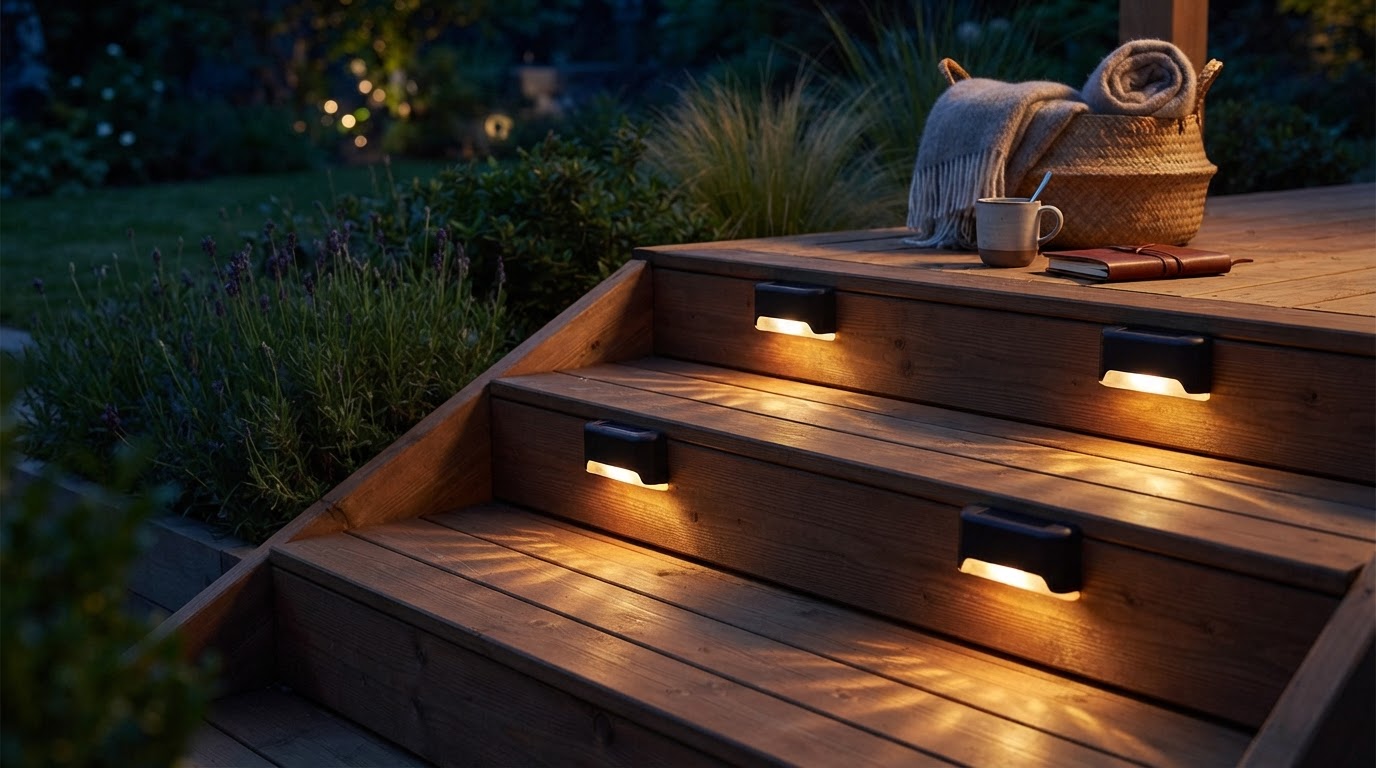
Solar Powered Deck Lights for Improving Dark Stair Safety
 Sam VasquezBuying Guide Lead
October 1, 2026. This guide details how to select and position solar-powered illumination to mitigate trip hazards on residential stairways. It is written for homeowners seeking reliable, wire-free safety upgrades for their outdoor living spaces.
The Risk Assessment of Unlit Outdoor Steps
Navigating a backyard or deck after sunset becomes a significant liability when elevation changes are involved. Standard porch lights rarely cast a consistent glow across every individual tread, often leaving the bottom two or three steps in total shadow. According to the National Safety Council, falls are a leading cause of preventable injury in the home, and uneven or poorly lit stairs are a primary contributor to these incidents. When I look at a dark staircase, I don't just see a lack of light; I see a zone where depth perception fails. The transition from a flat deck surface to a descending staircase requires a clear visual cue that many standard lighting setups miss.
I have observed that many people try to solve this by installing high-intensity floodlights. While this provides raw brightness, it often creates harsh glares and deep shadows that actually make it harder to see the edge of each step. A better approach involves low-profile, localized illumination that defines the perimeter of each tread. This is where specialized fixtures come in, particularly those designed to sit flush against the riser or the side stringer. If you are already looking into how to light outdoor stairs safely at night, you know that consistency matters more than raw lumens. You want a soft, steady glow that outlines the path without blinding the person walking down it. In my experience, the most common mistake is over-lighting the top and leaving the rest of the flight in darkness, which creates a false sense of security for the first few steps before the environment changes.
Technical Performance of Solar Powered Deck Lights
When evaluating Solar Powered Deck Lights for stair applications, the hardware needs to meet specific environmental standards. Based on search trends and user feedback, waterproof solar fence lights are highly sought after because they share the same mounting requirements as stair lights. These units must withstand direct rain and snow, especially since they are often mounted low to the ground where moisture accumulates. The internal components typically feature led solar stair lights which are preferred for their low energy draw and long lifespan.
In my testing of these systems, the color temperature is the most overlooked spec. Many users on Reddit forums specifically request warm white solar deck lighting because the softer 2700K to 3000K range provides better contrast against wood and composite decking than the sterile blue-white of older LED models. The light output needs to be functional but subtle. For a standard 4-foot wide staircase, a single light per step is usually sufficient if the beam angle is wide enough. If you are also considering how to install solar lights on deck railing, you can coordinate the stair units with railing caps to create a cohesive look. The efficiency of the solar panel is the engine of the device; modern monocrystalline panels can now harvest enough energy even on overcast days to provide 6 to 8 hours of illumination, which covers the critical high-traffic hours of the evening. I prefer units that use a simple two-screw mounting system, as this ensures the light stays flush against the wood and doesn't vibrate loose over time.
Selecting the Right Fixture for Your Layout
Choosing between different models comes down to your specific deck geometry. Between these two, I’d go with a recessed riser light over a surface-mounted tread light every time. Surface-mounted lights that sit on top of the step can become trip hazards themselves or get damaged by snow shovels in colder climates. If you’re on a budget, simple wedge-shaped lights that mount to the side stringers are a cost-effective way to get the job done without drilling into your main deck boards. However, for a professional finish, a flush-mounted LED that sits inside the riser provides the cleanest aesthetic and the most direct light on the footing area.
Here is what I’d actually buy: a set of weather-resistant, warm-white LED units with a matte finish. Skip this if your stairs are in a permanent shadow zone under a heavy tree canopy or a covered porch, as the batteries won't charge sufficiently to last through the night. Instead, look for models with a detached solar panel that can be positioned in the sun. When shopping, use this checklist to verify your choice:
- Check for an IP65 or higher waterproof rating to ensure longevity against rain.
- Verify the battery capacity (mAh) to ensure it can support the LED for at least 6 hours.
- Choose warm white (3000K) to avoid the "hospital" look of cool white LEDs.
- Ensure the mounting hardware is stainless steel to prevent rust streaks on your wood.
- Look for auto-on/off sensors so you don't have to manually toggle them daily.
To find the right fit for your home, Shop Solar Powered Deck Lights here.