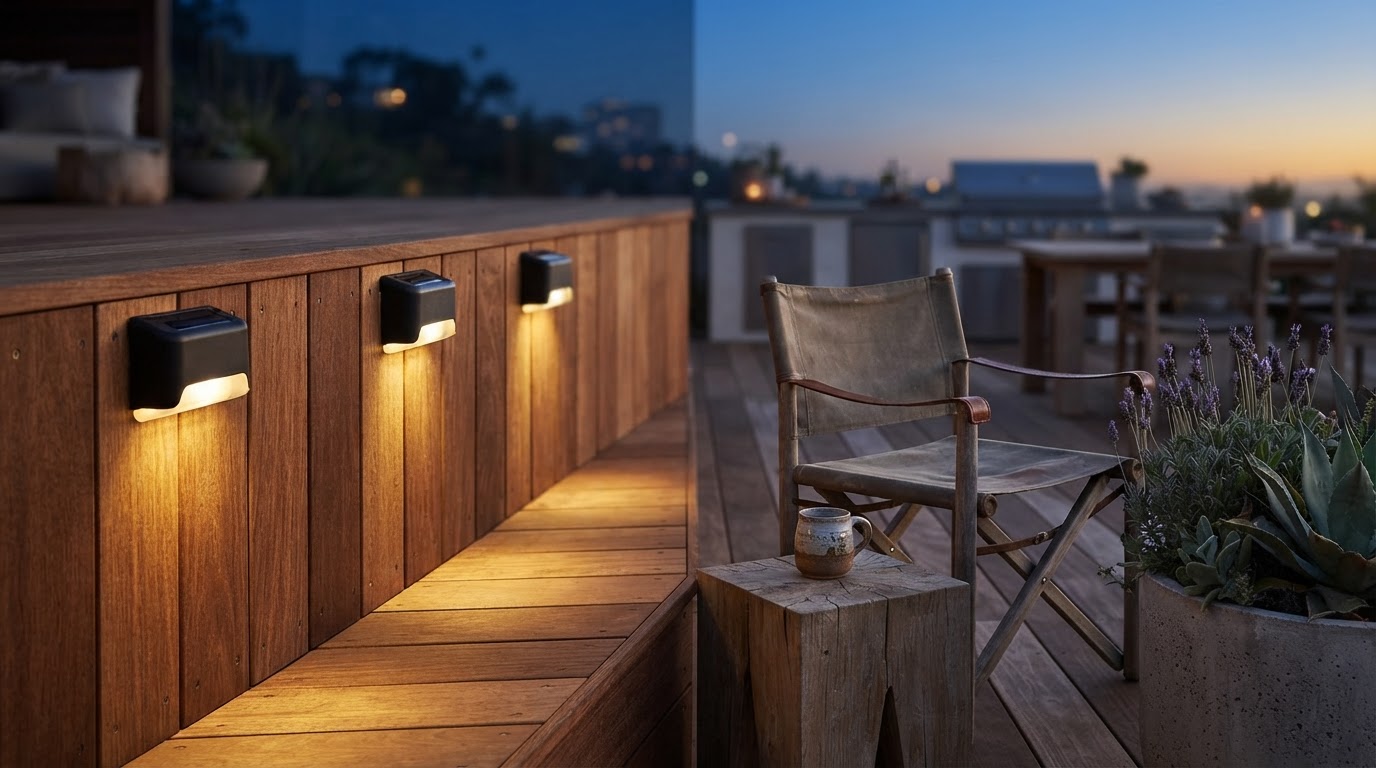
High-Output Solar Powered Deck Lights for Timber Surfaces
 Maya ChenContributing Editor
September 24, 2026. This analysis evaluates the light-intensity requirements for wooden decking installations and the specific hardware needed to secure fixtures without compromising timber integrity. It is intended for homeowners seeking functional illumination rather than purely decorative accents.
The Illumination Deficit in Standard Timber Lighting
The conventional wisdom says that any low-voltage or solar-powered fixture is sufficient for safety as long as it marks the perimeter of a wooden deck. However, this ignores the specific light absorption properties of dark-stained cedar, mahogany, or pressure-treated pine. Unlike Solar Powered Deck Lights for composite decking, which often benefits from the reflective sheen of synthetic materials, natural wood grains tend to swallow light, resulting in high-contrast shadows that increase trip hazards. According to The Deck Store, solar post caps are a primary solution for this, providing light at the railing level where it can cast a wider downward beam. The problem is that many entry-level units fail to provide the 30-lumen minimum necessary to penetrate the shadow cast by a standard 4x4 post. When you factor in the inevitable degradation of battery capacity, a light that starts at 10 lumens becomes functionally invisible within six months.
Run the math: a standard 20-foot wooden deck requires approximately 300 to 500 total lumens of distributed light to meet basic visibility standards for foot traffic. Relying on underpowered decorative units results in a "spotty" effect that confuses depth perception. This is particularly dangerous when considering solar step lights outdoor applications, where the difference between a 5-lumen glow and a 30-lumen beam determines whether a stair edge is visible. Furthermore, the installation of these lights on wood requires a different mechanical approach than other materials. Wood expands and contracts significantly with moisture levels, a factor that can shear the small plastic housings of cheap fixtures. If a light cannot withstand the seasonal movement of a timber joist, its internal circuitry will inevitably fail, regardless of its IP rating. We also see significant performance drops during shorter days, though some argue that solar deck lights for dark winter days can bridge the gap if the photovoltaic conversion rate is high enough. I’ll change my mind when I see a sub-$10 unit that can maintain a consistent 30-lumen output for more than four hours in mid-December.
Engineering for Lumens and Heat Dissipation
Solar Powered Deck Lights must overcome the inherent inefficiency of small-format photovoltaic cells to be useful on timber surfaces. Here's the part nobody talks about: heat management. While LED lights are cooler than incandescent bulbs, the integrated batteries in solar units are highly sensitive to the heat trapped by wooden surfaces during direct summer sun exposure. A fixture like the VOLT Solar Integrated LED Deck Light addresses this by utilizing a durable ABS plastic housing that emits 30 lumens of 2700K warm white light. This specific Kelvin temperature is critical for wooden decks; a cooler 5000K light often makes natural wood look gray and clinical, whereas the 2700K spectrum complements the organic tannins in the wood.
Performance standards for waterproof solar powered deck lights are not just about rain; they are about the humidity trapped between the light and the wood surface. If a light lacks a proper standoff or gasket, moisture will pool underneath the fixture, leading to wood rot and electrical shorting. Integrated LED units are superior here because they eliminate the user-error associated with poorly sealed battery compartments. The data from Gama Sonic suggests that high-quality solar deck and fence lights are now being engineered with larger monocrystalline panels to ensure that even a partial charge can yield a functional discharge cycle. This is vital for decks with overhead pergolas or nearby tree cover that restricts direct UV exposure. For those concerned about the longevity of their installation, verifying the specific battery chemistry—typically Lithium-ion or LiFePO4—is more important than the brand name on the box. These chemistries handle the rapid discharge cycles required for high-lumen output much more effectively than older NiMH alternatives. When selecting fixtures, the focus must remain on the lumen-per-watt efficiency of the LED chip itself, as this dictates how long the light will actually remain useful after the sun sets. If the fixture cannot provide a minimum of 5 hours of 30-lumen light, it is a decorative toy, not a safety feature.
Technical Requirements for Wooden Deck Integration
Choosing Solar Powered Deck Lights for a timber structure requires a departure from the "buy and stick" mentality of consumer-grade landscape lighting. The physical interface between the metal or plastic of the light and the organic fibers of the wood is a point of frequent failure. To ensure a professional-grade installation that survives the rigors of solar deck lights for dark winter days and high-traffic summers, a specific set of criteria must be met. The following framework prioritizes structural integrity and light density over aesthetic gimmicks.
- Lumen Density: Ensure each unit provides at least 30 lumens; anything less is insufficient for dark-stained wood surfaces.
- Fastener Quality: Only use stainless steel screws to prevent the "bleeding" of rust streaks down the wood grain.
- Color Temperature: Stick to 2700K–3000K to maintain the visual integrity of the natural wood grain.
- Battery Chemistry: Prioritize Lithium-ion (Li-ion) or Lithium Iron Phosphate (LiFePO4) for consistent discharge in cold weather.
- Mounting Standoffs: Select fixtures with a slight rear clearance to prevent moisture trapping against the timber.
Shop Solar Powered Deck Lights here
Sources
- Solar Deck Lights - Light Your Outdoor Space Without Wiring
- Buy Solar Deck Lights | Solar Post Caps - The Deck Store
- Outdoor Solar Lights for Fences, Decks & Pergolas | Gama Sonic