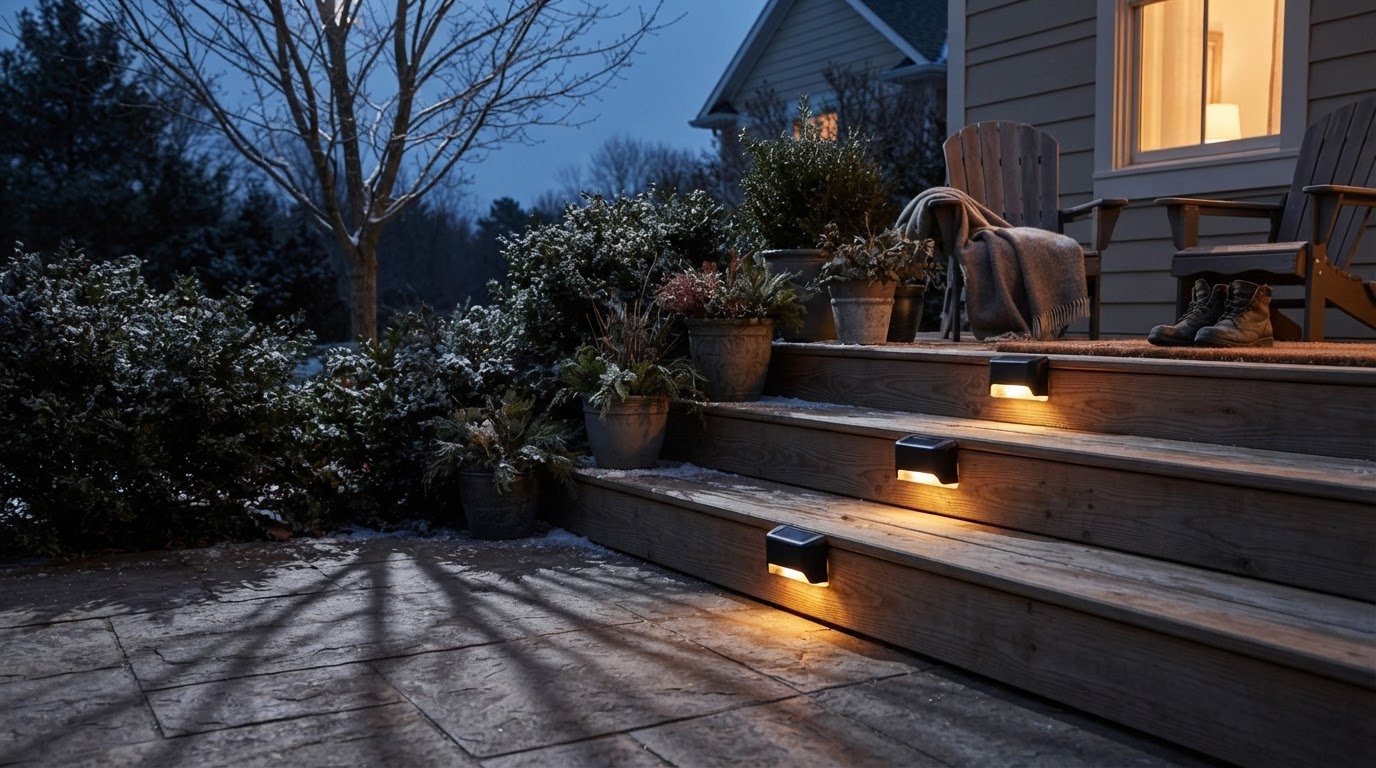
Can Solar Powered Deck Lights survive dark winter days?
 Jordan HaleStaff Writer
September 20, 2026 — While Solar Powered Deck Lights remain operational throughout the winter, users should expect a performance reduction of 30% to 50% due to shorter daylight hours and lower sun angles.
The first thing I noticed was the way the early December shadows stretched across my patio, swallowing the solar panels hours before I was ready for the day to end. Homeowners often worry that these systems will fail entirely when the frost hits, but the reality is more about managing expectations and positioning. Maintaining visibility on bright solar lights for wooden deck installations becomes a matter of physics rather than simple battery capacity.
How does reduced sunlight affect Solar Powered Deck Lights?
Reduced sunlight directly impacts the charging cycle, often resulting in shorter illumination times or a dimmer output during the night. According to data from Enkonnsolar, solar lights typically experience a performance dip of 30-50% during the winter months because the solar cells receive fewer photons to convert into stored energy. Somewhere around week two of the deep freeze, I realized that the angle of the sun was just as important as the duration of the light. If the panels are shaded by a gutter or a leafless branch, the charge may only sustain a faint glow rather than the robust beam seen in July. This is particularly noticeable with solar deck lights for composite decking, where the reflective surface of the deck might provide a slight ambient boost, but cannot compensate for a lack of direct overhead exposure.
What maintenance steps keep Solar Powered Deck Lights running in snow?
Keeping solar panels clear of debris and strategically angling them toward the southern sky are the most effective ways to maintain performance. Classy Caps suggests that regular cleaning of the solar panel surface is vital, as even a thin layer of dust, salt, or frost can significantly block UV rays from reaching the cells. I keep coming back to the simple habit of brushing off the snow after every flurry; it turns out that a clean panel can harvest energy even on an overcast Tuesday. For those in particularly harsh climates, ensuring you have waterproof solar deck lighting is essential to prevent internal moisture expansion during freeze-thaw cycles. Some specialized units, like the Linkind SolarDot, even offer wired charging backups or MPPT technology to squeeze every possible watt out of a grey sky.
Quick answers
Q: Do solar lights still charge when it is cloudy or snowing? A: Yes, solar panels can still process diffused light on cloudy days, though the charging efficiency is significantly lower than in direct sunlight. According to Enkonnsolar, you can expect a 30-50% drop in total runtime during these periods.
Q: What happens if my solar deck lights are covered in snow? A: If snow covers the photovoltaic cell, the light will not charge at all. Classy Caps recommends clearing the panels immediately after a storm to ensure the internal battery doesn't deep-discharge, which can shorten its lifespan.
Q: Are there specific solar lights recommended for extremely cold climates? A: Heavy-duty options are often preferred for high-latitude winters; for instance, Harbor Freight’s 1000-lumen solar units have been noted in community discussions for maintaining a bright output for 6 hours even in freezing temperatures, though they may fade to a glow after 12 hours.
Learn more about Solar Powered Deck Lights at https://solarpowerdecklights.com.
Sources
- How to Maximize Solar Light Performance During Short Winter ...
- Do Solar Lights Work In Winter?
- Outdoor Solar Lights That Work in Winter | Linkind SolarDot™