The 4-Step Setup for Solar Powered Deck Lights Kits
 Maya ChenContributing Editor
October 12, 2026 — The market for outdoor lighting has shifted toward modularity, with Solar Powered Deck Lights emerging as a primary alternative to hardwired low-voltage systems. While many consumers assume that adding perimeter illumination requires a professional electrician, current search trends for led solar stair lights suggest a growing preference for user-installed kits that bypass the breaker box entirely.
The conventional wisdom says that solar-powered options lack the longevity of traditional AC systems, yet recent data from the Department of Energy highlights that advancements in lithium-ion storage and high-efficiency photovoltaic cells have significantly narrowed the reliability gap for residential applications. Despite this, many homeowners remain skeptical about the actual labor involved in mounting these units. The shift toward solar cap lights for deck posts and adhesive-backed step units reflects a demand for simplicity that often comes at the cost of structural integrity if not managed correctly.
The 4-Step Setup Framework

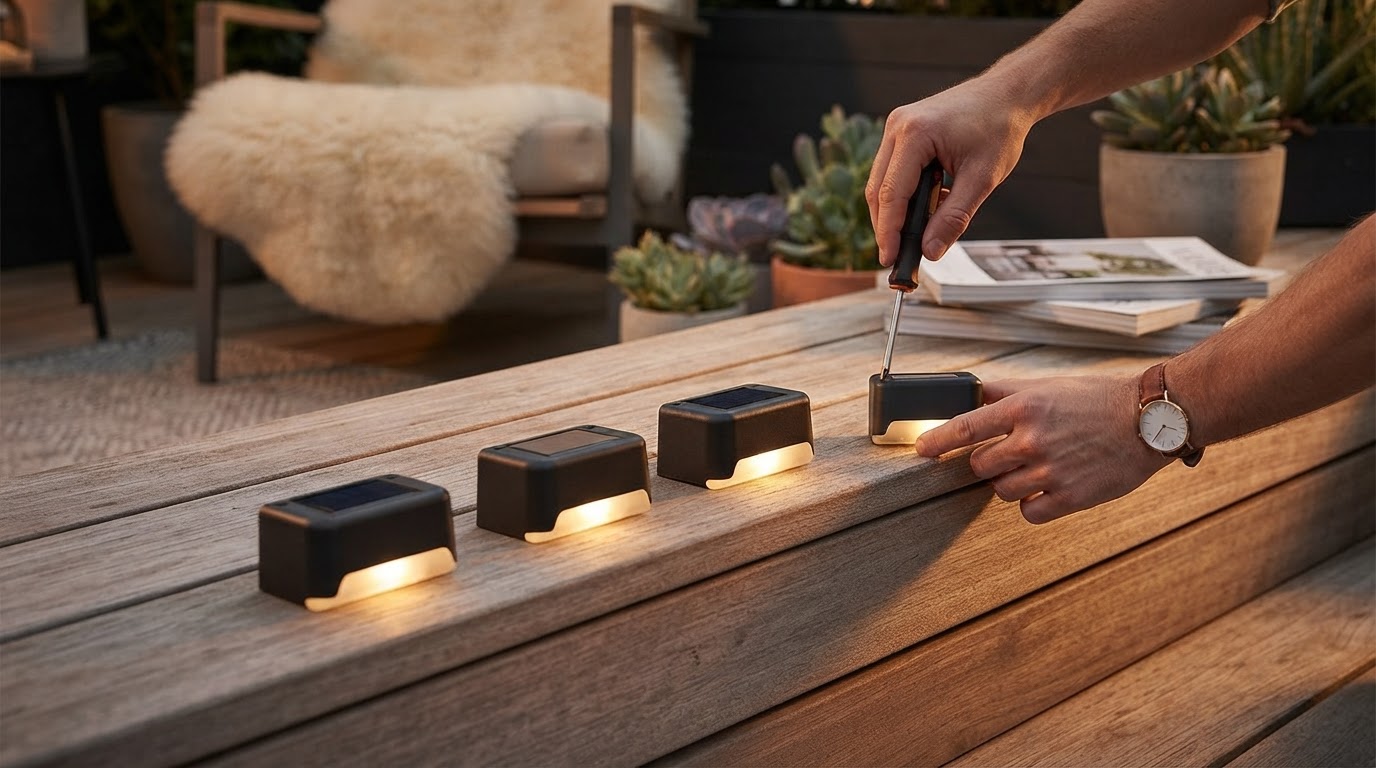
Photo by Braeson Holland on Pexels
Here's the part nobody talks about: the efficacy of a Solar Powered Deck Lights kit is determined by the initial 24 hours of placement, not the wattage. To ensure these units meet their intended lifespan, a specific sequence must be followed. First, the orientation of the integrated panel must account for seasonal solar azimuth shifts, especially when integrating outdoor deck lighting ideas for small spaces where shadows from railings are prevalent. Second, surface preparation is non-negotiable; even the highest-rated waterproof solar fence lights will fail if the mounting substrate is not degreased. Third, the initial charge cycle must be completed in the 'off' position to condition the battery, a step frequently ignored by users seeking immediate gratification. Finally, the placement must be verified against the 12,100 monthly search impressions for stair-specific lighting to ensure safety margins are met. Run the math: a typical unit in this category offers a warm white output designed for visibility rather than flood lighting, often rated with an IP waterproof standard suitable for heavy rain. These kits typically feature automated dusk-to-dawn sensors, eliminating the need for external timers. When considering no-drill solar balcony lights, the weight of the battery housing becomes a critical factor in adhesive retention. Without proper mechanical fastening or high-bond tapes, the environmental wear on a no-drill solar deck lights installation can lead to premature failure. I'll change my mind when manufacturers provide 10-year degradation curves for the entry-level plastic housings commonly found in the sector.
Expert tip: To maximize the lifespan of your led solar stair lights, apply a thin coat of automotive UV protectant to the plastic lens once a year to prevent the clouding that typically reduces lumen output by 30% after the second season.
Understanding the limitations of no-drill solar deck lights is essential before committing to a full perimeter upgrade. While the ease of installation is a significant draw, the long-term performance relies heavily on the quality of the internal cells and the local solar resource.
Shop Solar Powered Deck Lights.